Key points
- In 38 patients who all had an alar cinch suture after a Le Fort I operation, the nose widened by 1.7 mm on average (standard deviation 1.2 mm).
- In the same study, nose width rose 0.3 mm per 1 mm of upper jaw advancement and 0.5 mm per 1 mm of upward move (impaction).
- In a study of 140 people, widths rose by 3.70 to 4.29 mm after a Le Fort I osteotomy, and cinch sutures brought them back to the preoperative values, stable over 3 years.
- A meta-analysis of 4 randomised trials found no significant difference in width change between the conventional and a modified cinch technique.
The base of the nose can widen after a Le Fort I operation on the upper jaw, because the soft tissue around the nostrils is no longer held by the bone in the same way. Studies report widening of a few millimetres without countermeasures, and a stitch called an alar cinch suture is used to limit it. The findings depend on which width was measured and how the study was designed.
What is measured, and where?#
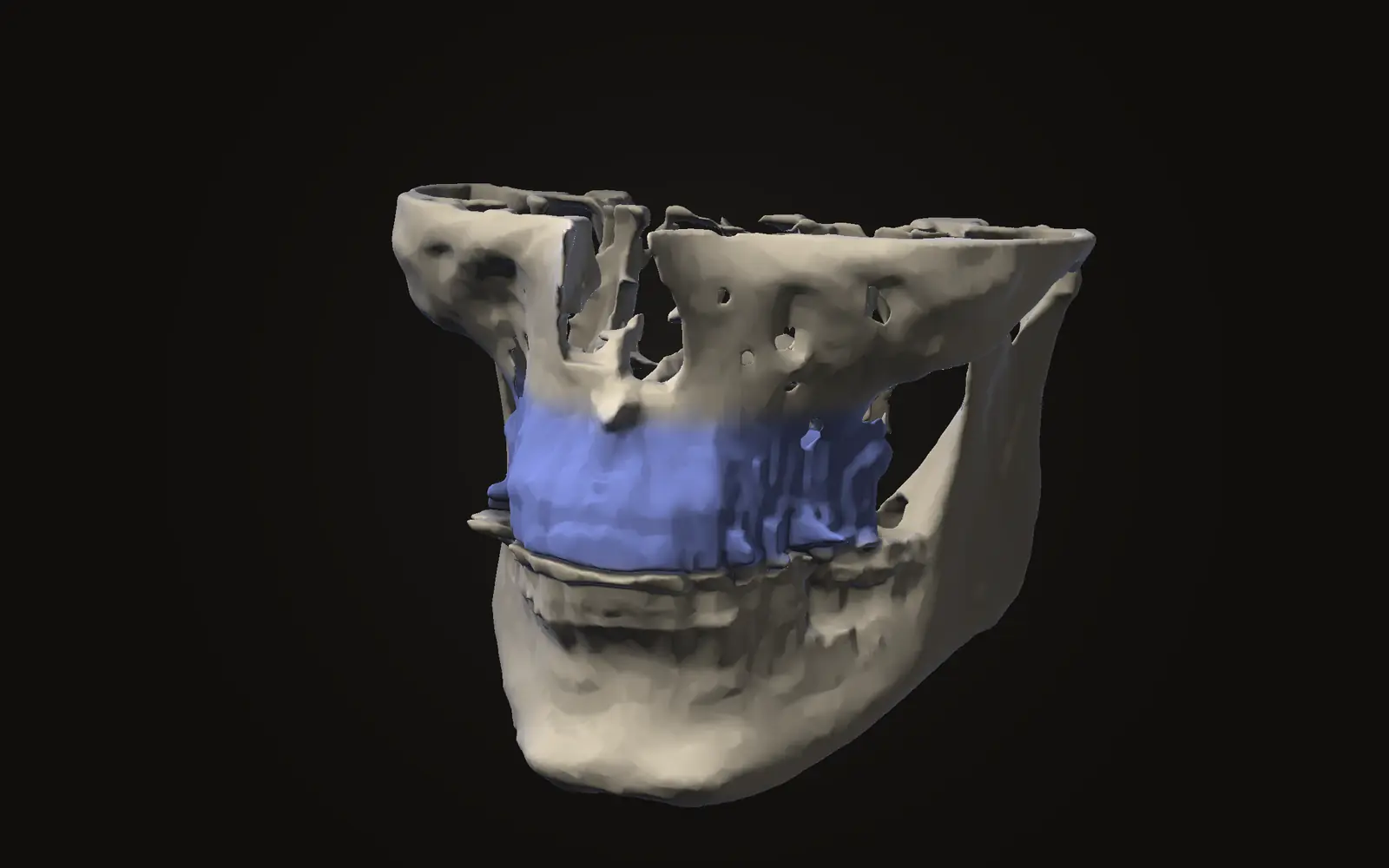
The upper jaw (maxilla) sits directly under the nose. In a Le Fort I osteotomy it is cut free from the nasal walls and moved, as described in the Le Fort I article. The soft tissue of the nose base then loses some of its support and can spread sideways. A cinch suture draws the two sides of the alar base together during closure, and a meta-analysis of trials describes the aim as preventing the increase in nasal base and alar width.[1]
Papers use different widths, so numbers are only comparable within one paper.
- Greatest inter-alar width is the widest distance across the nose wings. One study abbreviates it GAW.[2]
- Al-Al is the maximum lateral convexity of the wings, the outermost bulge on each side.[3]
- Ac-Ac is the lateral extremity of the alar base curve at the alar groove, a point lower and nearer the cheek.[3]
How much does the nose widen?#
A study from Verona looked back at 38 patients (15 men, 23 women) who had a Le Fort I osteotomy combined with a cinch suture. The inter-alar width changed by +1.7 mm on average, with a standard deviation of 1.2 mm.[2] Everyone in that group had the stitch, so it says how much widening remained with it, and nothing about operations without it.
A London study followed 140 participants aged 16 to 51 for up to 3 years. After the Le Fort I osteotomy there were significant increases in Ac-Ac (4.29 mm) and Al-Al (3.70 mm). Cinch sutures, used in 106 participants while 34 had none, significantly reduced the widths back to preoperative values. Over 3 years Al-Al rose by a further 0.36 mm, which was not significant, and Ac-Ac by 1.03 mm, which was.[3]
+1.7 mm
mean change in inter-alar width, 38 patients with a cinch suture[2]
3.70 to 4.29 mm
widening of Al-Al and Ac-Ac in 140 participants, before the cinch brought it back[3]
0.36 and 1.03 mm
Al-Al and Ac-Ac change from the first postoperative value to 3 years[3]
The studies used different cohorts, measuring points and designs, so subtracting one result from the other would not give a valid comparison.
Does a bigger move widen the nose more?#
In the Verona group, the regression analysis tied width to the direction of the move. Inter-alar width increased by 0.3 mm for each millimetre of upper jaw advancement and by 0.5 mm for each millimetre of impaction, meaning the jaw is moved up. It also increased by 0.2 mm for each degree of counterclockwise rotation of the occlusal plane, the tilt of the bite plane seen from the side.[2]
| Movement of the upper jaw | Change in inter-alar width |
|---|---|
| Advancement | 0.3 mm per 1 mm |
| Impaction (up) | 0.5 mm per 1 mm |
| Counterclockwise rotation of the occlusal plane | 0.2 mm per degree |
These are slopes fitted to 38 people with a cinch suture.[2] A slope describes how the group moved together, so it cannot say what one nose will do.
Does the type of stitch matter?#
Several cinch variants exist. A systematic review pooled 4 randomised trials that compared the conventional cinch with a modified technique. The alar base width change did not differ significantly (mean difference -0.37 mm, 95% confidence interval -1.32 to 0.57), and neither did the nasal alar width change in the 3 studies that reported it (mean difference -0.11 mm, 95% confidence interval -1.18 to 0.95).[1] The intervals are wide compared with the differences themselves, so the pooled trials cannot rule out a difference of a millimetre either way.
Looking at the nose on two scans#
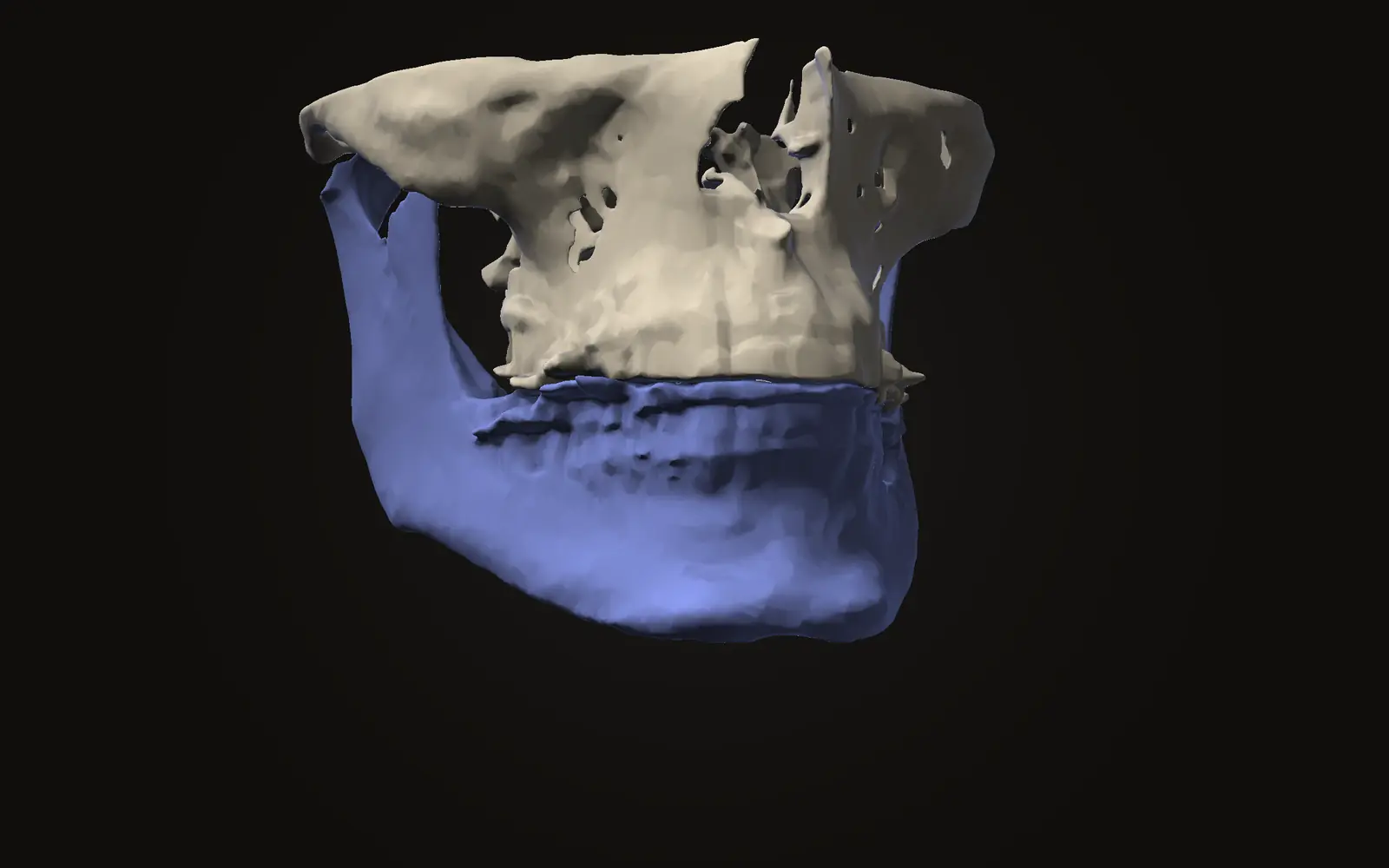
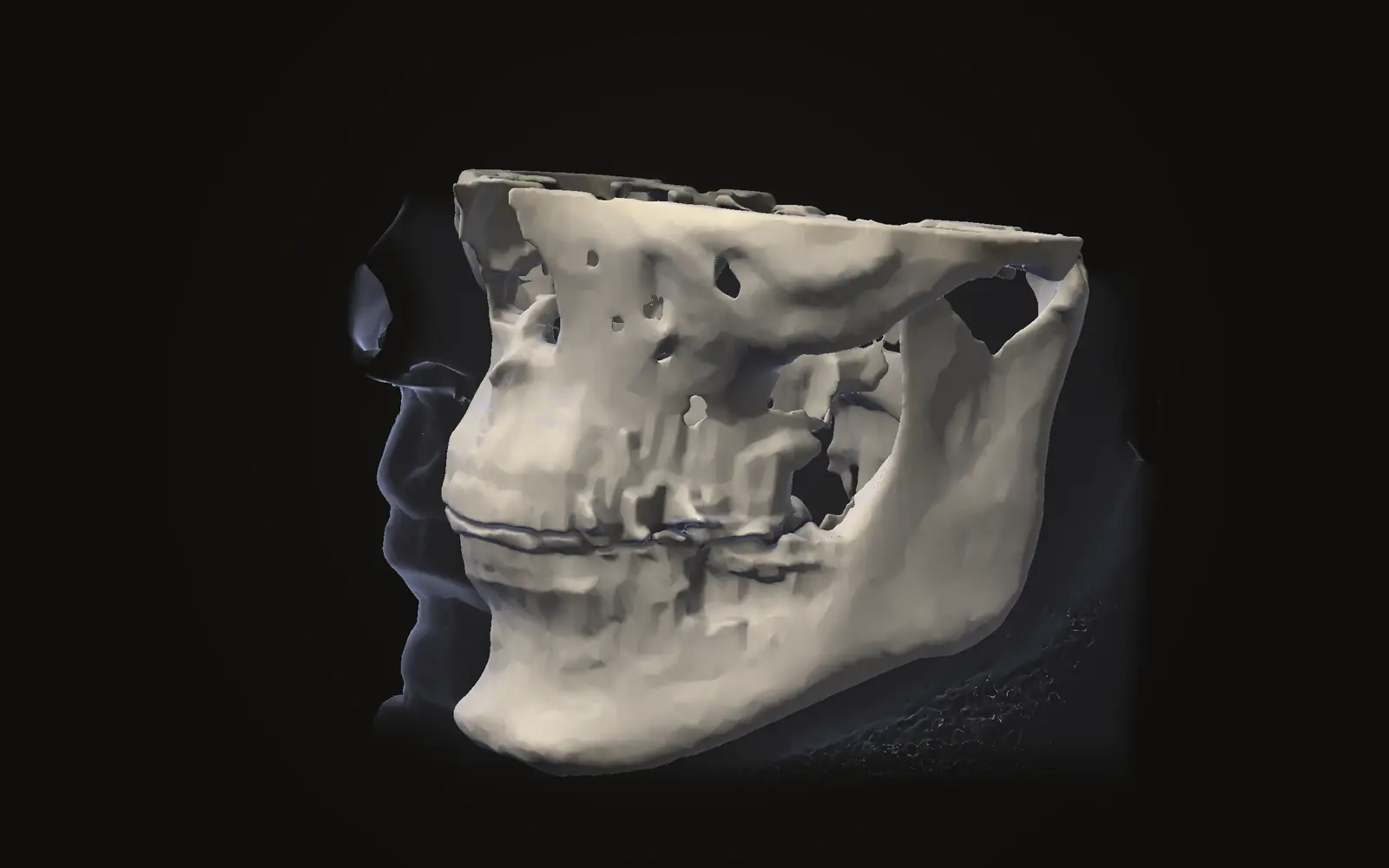
With a scan from before and one from after surgery, Jaw Viewer can line the two up on the skull base and show the skin of each date as see-through. You can place a point on the outer edge of each nose wing on both dates and read the distance between them, as covered in the guide on viewing and measuring and the guide on comparing scans. The background to the alignment is in the article on comparing before and after scans.
This measures a difference between two dates. Swelling, facial expression, head position and where the points are placed all change the number, and it tells you nothing about what to expect from an operation. The studies above measured the nose on the face and with calipers or photographs, not with this method, so their figures do not transfer to it.
Does the nose get wider after upper jaw surgery?
It can. One study of 140 people found the nose base widened by 3.70 to 4.29 mm after a Le Fort I osteotomy, and that cinch sutures brought the widths back to the preoperative values.
What is an alar cinch suture?
A stitch that draws the two sides of the nose base together at the end of the operation. It is placed to limit the widening that moving the upper jaw can cause.
Does moving the jaw further widen the nose more?
In 38 patients with a cinch suture, nose width rose 0.3 mm per 1 mm of advancement and 0.5 mm per 1 mm of impaction. That describes a group, not any one person.
Sources
- Yang JR, Chu YY, Liao HT, et al. (2023). Comparison of the effectiveness between conventional and modified cinch suture techniques in LeFort I osteotomy: a systematic review and meta-analysis of randomized control trials. Ann Plast Surg, 90: S2-S9. Meta-analysis of 4 randomised trialsDOIPubMed
- Trevisiol L, Lanaro L, Favero V, et al. (2020). The effect of subspinal Le Fort I osteotomy and alar cinch suture on nasal widening. J Craniomaxillofac Surg, 48: 832-838. Retrospective, 38 patients, all with a cinch sutureDOIPubMed
- Raithatha R, Naini FB, Patel S, et al. (2017). Long-term stability of limiting nasal alar base width changes with a cinch suture following Le Fort I osteotomy with submental intubation. Int J Oral Maxillofac Surg, 46: 1372-1379. 140 participants, 106 with and 34 without a cinch suture, followed up to 3 yearsDOIPubMed
Terms used
- Maxilla
- The upper jaw bone. It carries the upper teeth and forms the roof of the mouth, the floor of the nose and part of the cheekbone area.
- Le Fort I osteotomy
- A planned cut through the upper jaw above the teeth, so the whole tooth-bearing part can be moved and fixed in a new position.
- Alar cinch suture
- A stitch that draws the two sides of the nose base together at the end of an upper jaw operation, placed to limit the widening that the operation can cause.
- Alar base
- The base of the nose where each nostril wing (ala) meets the cheek. Its width is one way to describe how wide the nose is.
This is general information, not medical advice. Jaw Viewer is not a medical device. Talk to your surgeon, orthodontist or radiologist about your own case.