Key points
- Genioplasty changes the position and contour of the chin. A 2025 review of 105 articles covered 5,218 patients, 3,560 of them with genioplasty as the only procedure.
- In five studies with at least 12 months of follow-up, the chin skin followed the bone at 1:0.77 to 1:0.91 front to back two or more years after the operation.
- At 3 years the soft tissue had relapsed more than the bone in the front-back direction. In the vertical direction the results varied widely.
- A review of 33 articles suggested a skin-to-bone ratio of 0.9:1 for chin advancement and 0.55:1 for setback, and called for better studies.
Genioplasty is an operation that cuts and repositions the chin bone, which changes the position and contour of the chin.[1] Reviews find that the skin follows the bone only partly, that the soft tissue moves back more than the bone over several years, and that the evidence for isolated chin operations is thin. The findings describe groups and cannot tell an individual what to expect.
What a genioplasty is#
A genioplasty belongs to the family of orthognathic operations, next to the upper jaw (Le Fort I) and lower jaw (BSSO) operations. The overview of orthognathic surgery shows where it fits. A genioplasty can be done on its own or together with other jaw operations.
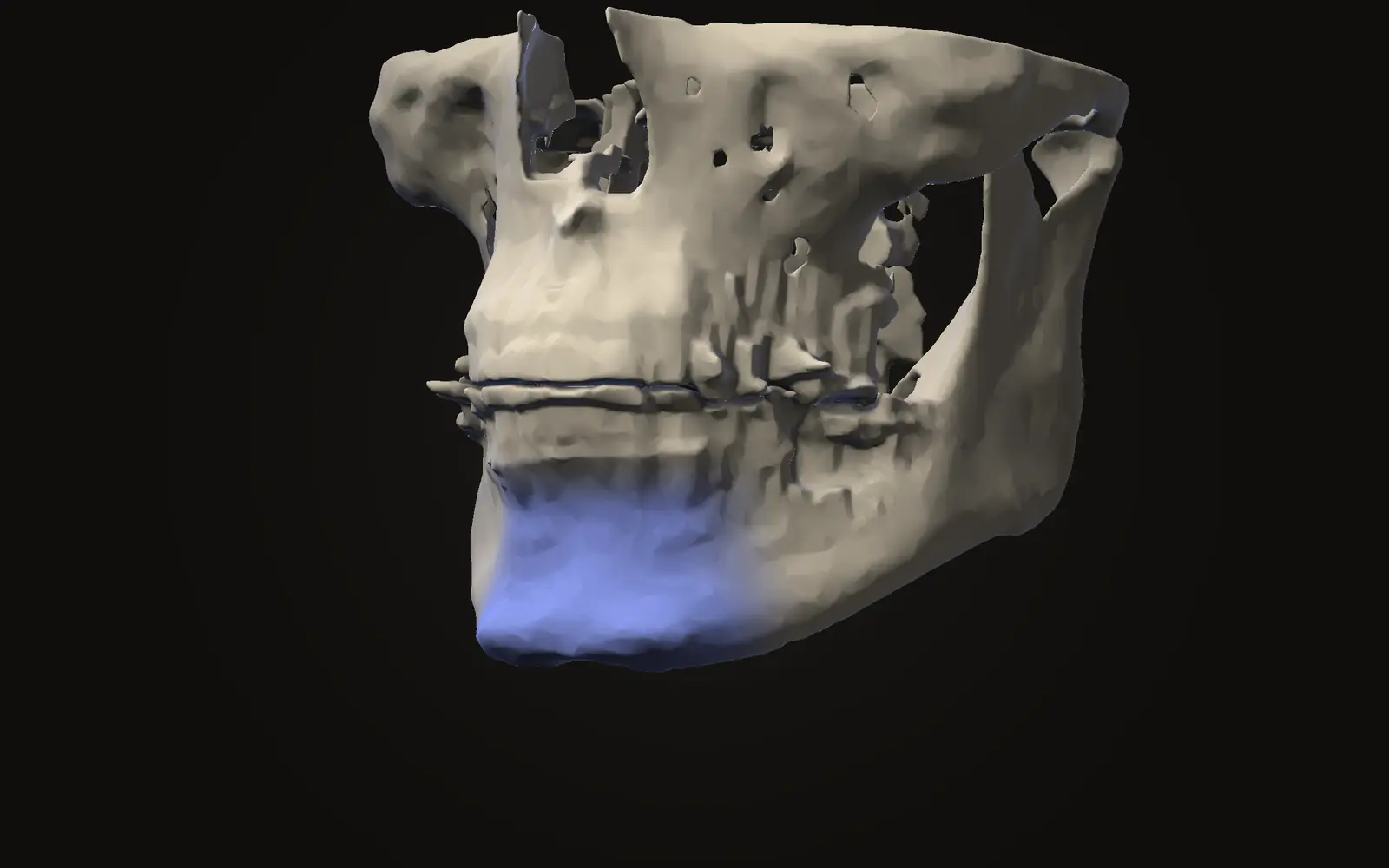
The most common form is the sliding genioplasty, which is a chin osteotomy: a cut in the chin bone so the piece can be moved.[2] Reviews also name two other approaches, osseous chin recontouring and alloplastic chin augmentation, where material is added to the chin.[2] Everything below is about the bone operation.
How much has been studied?#
A 2025 systematic review screened 2,563 references and included 105 articles from 25 countries. Together they covered 5,218 patients, 3,560 who had genioplasty alone and 1,696 who had it with other orthognathic procedures. About 64% were female.[3]
105 articles
in the 2025 review[3]
5,218 patients
across those articles[3]
5 studies
with 12 months or more of follow-up on isolated genioplasty[1]
Many reports exist, but few follow an isolated chin operation for a year or longer. The 2025 review found that objective evaluation focused on surgical accuracy, relapse and neurosensory disturbance, while subjective assessment focused on appearance and satisfaction. It also found no standardised method for evaluating isolated genioplasty outcomes.[3]
How closely does the skin follow the bone?#
Soft tissue does not move one to one with bone. A ratio of 1:0.8 means the skin moved 0.8 mm for each 1 mm the bone moved. A review of chin procedures included 33 articles, three of them prospective. It suggested that a ratio of 0.9:1 between the skin point at the chin and the bone point could be used for chin advancement, and 0.55:1 for chin setback.[2] The authors note that the high variability in the results largely disappeared once data were grouped by confounding factors, and they ask for prospective studies that do this.[2] The soft tissue article explains how these ratios are measured and why they describe groups.
A second review looked only at isolated genioplasty with data from at least 12 months after the operation. It found five studies, two of good quality and three of moderate quality.[1] Two years or more after the operation, the hard to soft tissue response in the front-back direction ranged from 1:0.77 to 1:0.91. In the vertical direction it ranged from 1:0.67 to 1:1.16.[1]
| Direction | Hard to soft response, 2 years or more | Source |
|---|---|---|
| Front-back | 1:0.77 to 1:0.91 | 5 studies |
| Vertical | 1:0.67 to 1:1.16 | 5 studies |
Does the chin move back?#
The same review reports that in the front-back direction the soft tissue relapsed more than the hard tissue at 3 years. In the vertical direction, relapse of both hard and soft tissue varied widely between studies.[1] Its authors describe the risk of bias as moderate for most domains.[1]
Older work on stability gives a broader picture. A 2007 review that ranked surgical movements by stability concluded that repositioning of the chin is very stable with rigid fixation.[4] The same review also states that changes of more than 2 mm occur in a surprisingly large percentage of orthognathic patients one to five years after treatment.[4] The two statements concern different things, the bone in one case and overall results in the other, and the reviews do not reconcile them. Relapse after jaw surgery lays out that evidence for all the jaw operations.
What about feeling in the lip and chin?#
Feeling in the chin and lower lip depends on the inferior alveolar nerve, whose mental branch leaves the jaw at the mental foramen. The 2025 review lists neurosensory disturbance among the outcomes studies most often measure objectively.[3] Its abstract gives no pooled rate. The better-studied lower jaw split operation is covered in lip numbness after BSSO, where reviews explain why reported figures range so widely.
What your own scan shows of the chin#
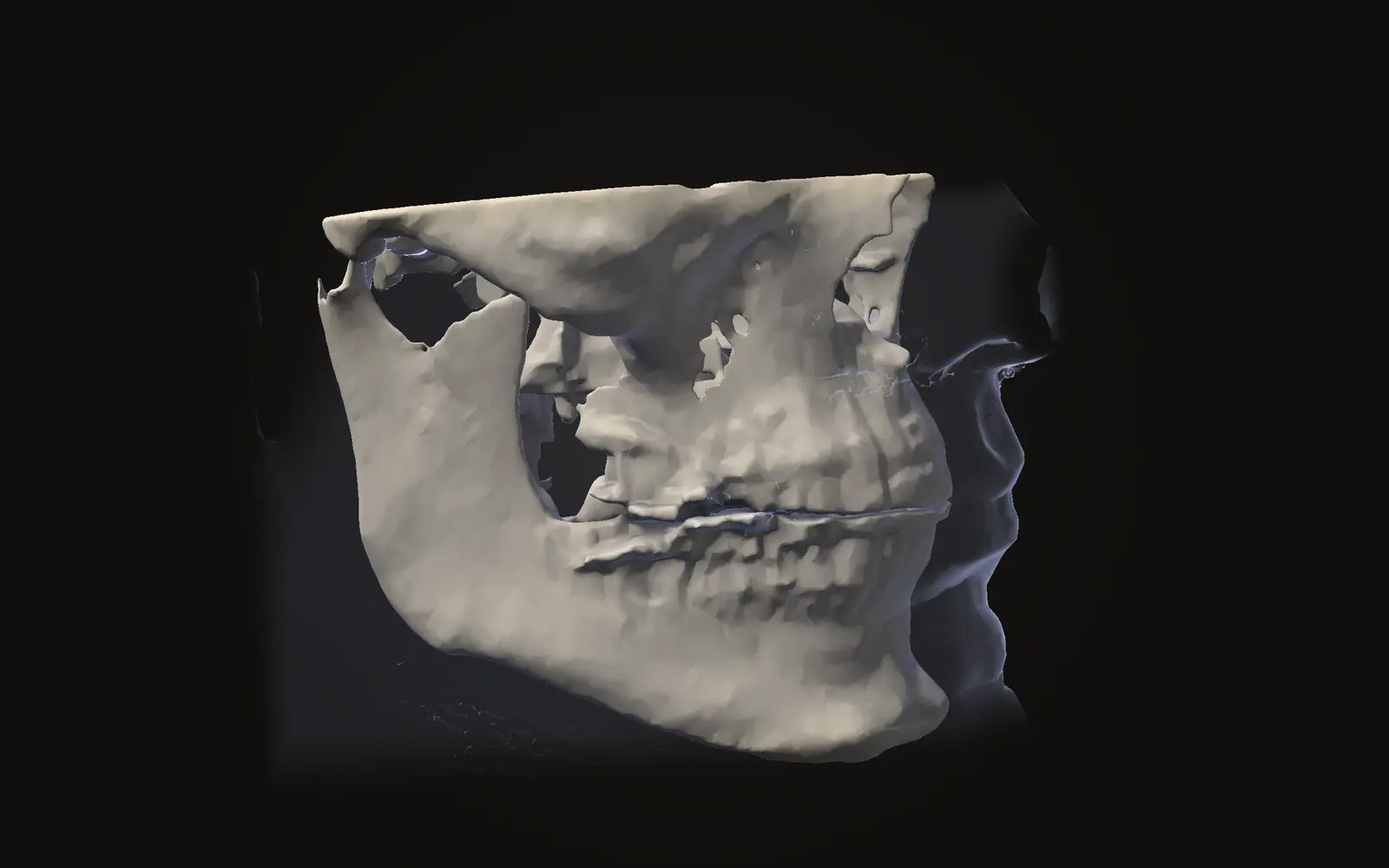
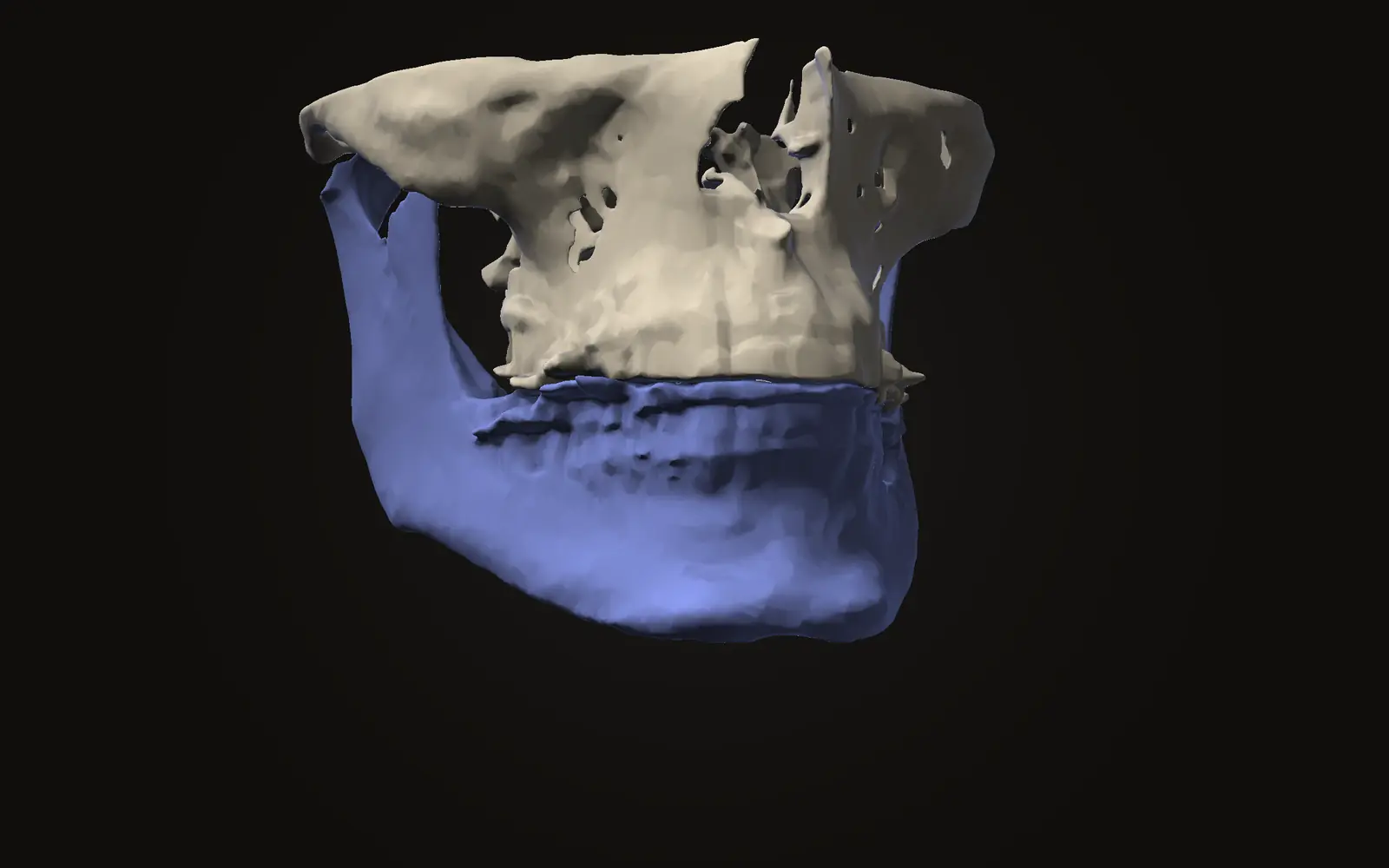
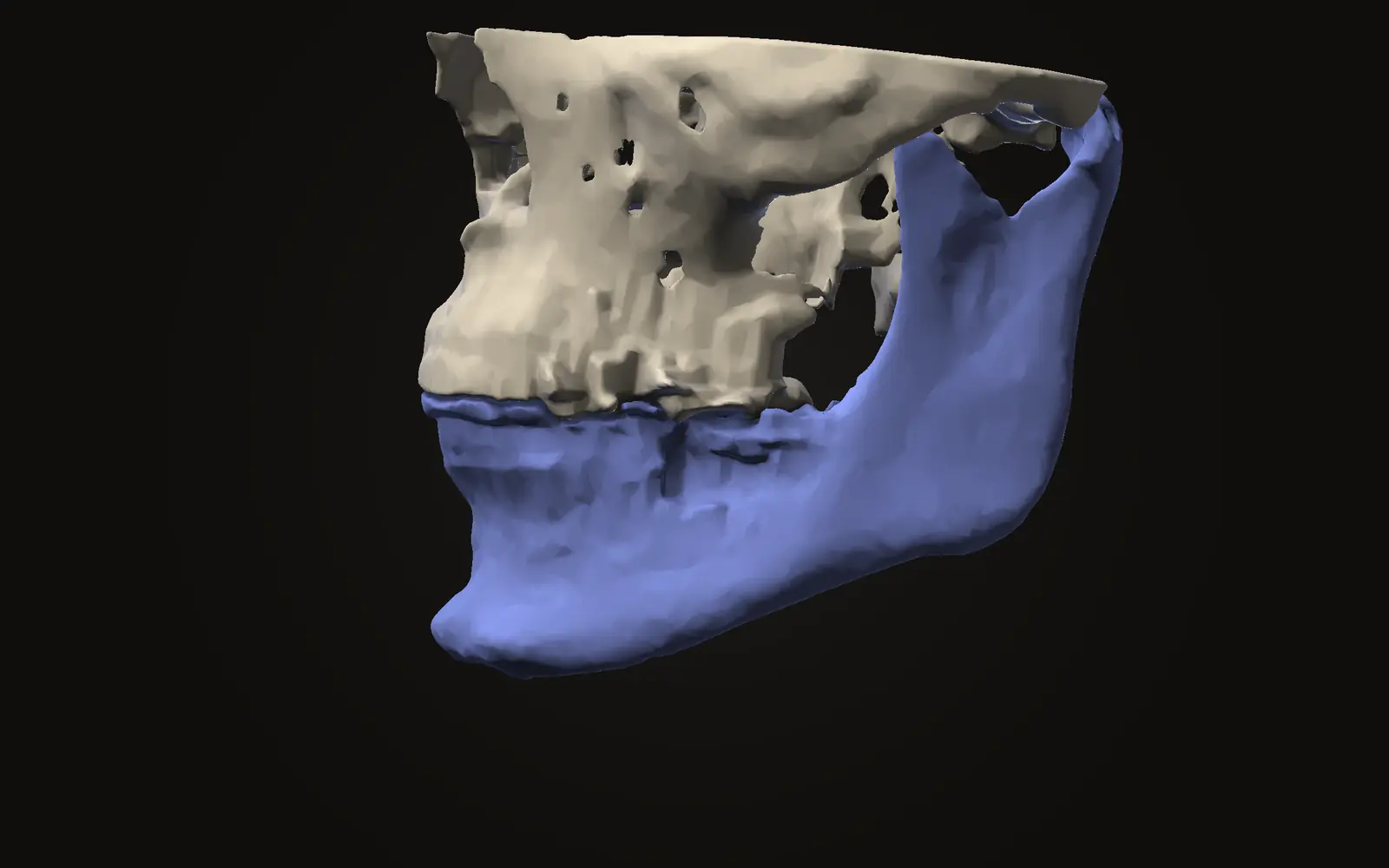
On a CBCT scan the chin bone, its lower border and the mental foramen are visible in slices and in the 3D view. Jaw Viewer lets you scroll through the slices in three directions, turn the bone in 3D and measure a distance in millimetres, as the view and measure guide explains. It can also trace the nerve canal, which is described in the nerve canal on CBCT. It does not show what an operation would change, how the skin would follow, or how likely any outcome is.
What is a genioplasty?
An operation that cuts the chin bone and moves it, changing the position and shape of the chin. Reviews describe it as altering chin position and contour, and it can be done alone or with other jaw operations.
Does the chin move back after a genioplasty?
A review of five studies found that at 3 years the soft tissue had relapsed more than the bone in the front-back direction. Vertical results varied widely. The evidence is limited.
Is a sliding genioplasty the same as a chin implant?
No. A sliding genioplasty is a chin osteotomy, a cut in the bone. An alloplastic implant adds material to the chin. One review examined ratios for both, plus osseous recontouring.
Can a scan show the chin bone before a genioplasty?
Yes. Slices and a 3D view show the chin bone, its lower border and the mental foramen. A scan view cannot say what an operation would change or how the skin would follow.
Sources
- George JA, Kannan A, Kailasam V (2022). Long-term hard and soft tissue response following isolated genioplasty: a systematic review. Oral Maxillofac Surg, 26: 195-203. Five studies with at least 12 months of follow-up; moderate risk of bias for most domainsDOIPubMed
- San Miguel Moragas J, Oth O, Büttner M, et al. (2015). A systematic review on soft-to-hard tissue ratios in orthognathic surgery part II: Chin procedures. J Craniomaxillofac Surg, 43: 1530-40. 33 articles, 3 of them prospectiveDOIPubMed
- Dalmeijer SWR, van Riet TCT, Ho JTF, et al. (2025). Evaluating genioplasty procedures: a systematic review and roadmap for future investigations. Craniomaxillofac Trauma Reconstr, 18: 5. 105 articles, 5,218 patientsDOIPubMed
- Proffit WR, Turvey TA, Phillips C (2007). The hierarchy of stability and predictability in orthognathic surgery with rigid fixation: an update and extension. Head Face Med, 3: 21.DOIPubMed
Terms used
- Genioplasty
- An operation that cuts and repositions the chin bone.
- Osteotomy
- A planned cut in a bone.
- Inferior alveolar nerve
- The nerve that runs through a canal inside the lower jaw and supplies feeling to the lower teeth, lip and chin.
- Mental foramen
- The opening on the outer surface of the lower jaw where the canal ends and the mental nerve comes out.
This is general information, not medical advice. Jaw Viewer is not a medical device. Talk to your surgeon, orthodontist or radiologist about your own case.